






















At 8:12 a.m., Jorge Juan is already answering messages.
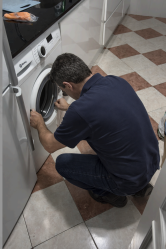
Standing in the doorway of a narrow, interior-facing apartment in Lavapiés, he scrolls through his phone with one hand while testing a washing machine with the other. The drum hums, then stops. A faint smell of detergent lingers in the air, and the tiled kitchen floor is still damp from a previous load.
“Sometimes it’s small things like this,” he said. “But if you don’t fix them early, they become bigger problems.”
For most tenants, Juan is just a name saved in their phone.
“You text him and he actually answers,” said María Carmen López, 47, who lives in one of the units managed by Juan.
A machine that won’t start, a lock that won’t turn, a question about heating. The messages usually come early in the morning.
In Madrid’s fast-moving rental market, where international students and short-term tenants cycle through apartments every few months, that kind of responsiveness stands out. As demand rises
and turnover accelerates, landlords and property managers like Juan operate behind the scenes, shaping daily life for tenants navigating a new city.
Juan, 52, manages several apartments in central Madrid, primarily in Lavapiés and nearby neighborhoods. He works on behalf of property owners, overseeing tenant turnover, maintenance, and day-to-day issues. Most of the apartments are two-bedroom units in older buildings, with narrow staircases, interior-facing windows, and aging plumbing systems common in 19th-century constructions.
Most of his tenants are international students staying for a semester or less, a group that often relies on quick responses when problems arise.
“The only issue we’ve had was the washer, and he had someone here the next day,” said Lexie Laurent, 21, who rents one of Juan’s apartments.
“He’s honestly one of the better landlords I’ve had,” López said. “Things get handled pretty fast.”
Juan did not originally plan to work in housing.
In his early 20s, he began helping a family acquaintance prepare apartments between tenants, cleaning units, handing over keys, and checking for damage.
“At the beginning, it was just helping out,” he said. “Nothing serious.”
But the work exposed him to patterns most tenants never see.
“You see how people really live in a place when you’re the one cleaning it after,” he said. In older buildings with frequent turnover, certain problems appeared again and again. “Washing machines break a lot,” he said. “People overload them, or they use the wrong settings.” Plumbing issues were also common, especially in kitchens and bathrooms. “Drains get blocked, pipes leak,” he said. “And if you don’t fix it early, it spreads.” Doors, locks, and heating systems were another frequent source of calls.
“Keys get stuck, heaters stop working in winter,” he said. “It’s usually minor, but it matters to the person living there.”
Over time, those repeated issues shaped his approach.
“I realized it’s easier to stay ahead of things than fix them later,” he said.
That philosophy has become more important as Madrid’s rental market has shifted.
In recent years, an increase in international students and remote workers, along with Spain’s digital nomad visa, has accelerated demand for short-term housing in central neighborhoods. Apartments turn over more quickly, and maintenance cycles have shortened.
“There are more people coming for shorter stays,” Juan said. “Everything moves faster now.” With higher turnover comes more wear.
“A lot of places aren’t maintained between tenants,” he said. “Things only get fixed when they break.”
Juan tries to intervene earlier.
Between tenants, he inspects each apartment, checking appliances, testing plumbing, and looking for early signs of damage. He runs taps, opens windows, and checks for leaks under sinks.
“It’s usually small things,” he said. “But if you fix them early, you avoid bigger problems.” Still, much of his work is reactive.
“You wake up and there are already messages,” he said.
“If something comes up, it’s on me,” he said. “Half the job is just answering people.”
For many of his tenants, that responsiveness makes a difference, especially while adjusting to a new country.
“Moving here was stressful, so it helped having someone responsive,” Laurent said. “He explained how things work.”
Erin Reid, 21, who has lived in multiple apartments in Madrid during her semester abroad, said the difference often comes down to communication.
“I’ve had landlords who take days to respond or just don’t fix things properly,” she said. “With Jorge, it’s different. You know it’ll get taken care of.”
That consistency can shape how tenants experience the city itself.
“When everything else is new, having that reliability matters more than you think,” Reid said. Despite that impact, Juan’s work often goes unnoticed.
“You don’t really think about your landlord unless something’s wrong,” one tenant said. “With him, it’s usually fine.”
Outside of work, Juan tries to maintain a routine that separates him from the constant demands of the job.
He lives just outside the city center and starts most mornings before the first messages come in. When he can, he goes for a walk through his neighborhood or through the streets of Madrid, something he says helps clear his head before the day begins.
“I try to have a normal routine,” he said. “If not, the day just becomes work from the start.”
He spends his free time with his wife and daughter, who is in high school, and tries to keep part of his day focused on family.
“That’s important to me,” he said. “To have time that isn’t about work.”
He also meets friends to play card games when he can, small routines that break up the pace of the week.
Still, the boundaries are not always clear.
Even during those moments, his phone remains close by, screen lighting up with new messages from tenants.
“You can’t ignore it completely,” he said. “Something always comes up.”
For tenants, he remains largely invisible, a contact saved in their phone, a name that appears only when something needs fixing.
“If everything’s working,” he said, “that means I’m doing my job.”