



On a crowded night in Madrid, Hannah Allen was walking a friend home from a club when she rolled her ankle in a pair of heeled Steve Madden boots. It felt minor – just a quick misstep, a flash of pain, nothing worth stopping for.
By morning, she couldn’t walk.
“I literally threw the boots away,” Allen said. “At that point, they had done enough damage.”
Just hours later, she was supposed to board a flight to Morocco, a trip she had been planning for weeks. Instead, she sat in her room, her foot swollen and throbbing, her plans unraveling in real time.
Allen, a University of Georgia student studying abroad at SLU Madrid, has become a familiar presence on campus. The crutches tucked under her arms make her easy to spot, but it’s her attitude that people remember.
After fracturing two bones in her foot, Allen was forced into a version of study abroad she hadn’t planned for – one defined less by independence and constant travel, and more by adaptation and community.
Now, she moves through campus on handheld crutches, asking classmates to hold doors or translate at doctor’s appointments, often laughing as she does it.
While many students arrive abroad expecting freedom and spontaneity, Allen’s semester has taken a different shape, offering a glimpse into what happens when those expectations are suddenly interrupted.
On a warm afternoon in the Padre Rubio courtyard, Allen moves slowly, but never quietly.
What should be a quick walk across the space becomes a series of pauses. She stops to ask a classmate for help with a heavy door. Then she pivots – carefully – to greet a friend seated at one of the outdoor tables. A few steps later, she’s pulled into yet another conversation.
Her crutches press into her forearms as she shifts her weight, pausing briefly before continuing forward. Even small movements require effort, but she rarely lets that slow the rhythm of her interactions.
“I talk to more people now than I did before,” Allen said.
The shift wasn’t immediate. The morning after her fall, the reality of the injury set in quickly.
“We just heard her say, ‘Guys, something’s wrong,’” her roommate, Kayley Kish said. “Her foot was insanely swollen. She tried to stand, and she couldn’t.”
At first, Allen thought she might still make the trip to Morocco.
“But Morocco’s not somewhere you can go if you can’t walk,” Kish said. “We all kind of realized that at the same time.”
Allen canceled the trip that morning. She was able to get partial refunds, but the disappointment lingered.
“It was something I’d really been looking forward to,” Allen said.
Instead of traveling, she found herself navigating a Spanish medical system she didn’t fully understand.
“It was a lot of Google Translate,” Allen said. “Honestly, that was more stressful than the injury itself.”
Doctor’s visits, X-rays and unfamiliar terminology replaced airport gates and itineraries.
“Hannah has been incredibly resilient in her time of handicap,” her friend, Reede Newhouse, said. “A lot of people would have just shut down. She didn’t.”
Instead of staying home and wallowing, Allen began looking for ways to keep moving.
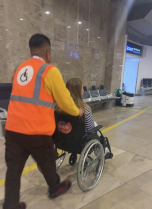
“She went to an accessibility store and rented a scooter,” Newhouse said. “That’s not really something you see in Madrid.”
The scooter – bulky, functional and hard to miss – quickly became part of her routine. Its wheels bump along uneven pavement on narrow sidewalks and crowded walkways. Allen guides it through foot traffic that doesn’t always expect her.
“People stare. They ask questions,” Newhouse said. “But it’s what allows her to get to class and still travel.”
Allen notices the attention, but she treats it more like a joke than a burden.
“I told her I’m going to build her a red velvet footrest and push her around the city,” her classmate Anya Offit said.
Allen laughed from her seat beside the scooter.
“You don’t have to tell me twice,” Allen said.
Even the smaller inconveniences have become something she can joke about. The crutches, which force her to carry her weight on her arms, quickly became painful to use.
“She went to a little store, bought towels and taped them onto the handles,” Offit said. “It actually helped,” Allen said. “A little.”
Despite everything, Allen hasn’t slowed down as much as expected. Over spring break, she traveled to Malta, spent a day in Rome and went on a seven-hour wine tour through Tuscany.
“We walked about a quarter of a mile up this huge hill,” said Hannah Giambastiani, who traveled with her in Italy.
“She had to do it all on crutches, and then all the way back down,” Giambastiani said. The group offered to adjust their plans, but Allen didn’t want to miss anything.
“She still wanted to see everything,” Giambastiani said. “She doesn’t complain. She just goes with the flow.”
That mindset carried into every stop. In Malta, friends helped her into the ocean so she could swim. In Rome, she made it to all the major landmarks despite the added difficulty. In Dublin, during a St. Patrick’s Day trip, the injury even came with unexpected perks.
“My friends and I got to skip all the lines at Temple Bar,” Allen said with a grin. “They would just bring us right in.”
“I’m not going to lie,” she added. “That part was pretty nice.”
Back in Madrid, daily life still requires more planning. Simple tasks take longer, and getting around the city isn’t as easy as it once was.
But Allen hasn’t pulled back. If anything, she’s become more present in the moments around her. She lingers longer in conversations. She asks for help without hesitation. What might feel like limitations instead become openings – small moments of interaction that shape her days in ways she didn’t expect.
In the courtyard, she pauses again to greet someone across the tables. Then she readjusts her grip on the crutches and keeps moving.
“I mean, this isn’t exactly how I imagined my semester going,” Allen said. “But honestly, it hasn’t been that bad. I could get used to this princess treatment.”