












After grabbing cardboard boxes off the side of the street, Isabel Sillers, 19, hovers over the coffee table, painting across her sign, “El Pueblo Unido Jamás Será Vencido”, or “A People United Will Never be Divided.” In bold letters her roommate paints “FUERA ICE” on her own piece of salvaged cardboard. They bundle up and shuffle out into the relentless Madrid rain. Equipped with umbrellas and signs, but leaving IDs at home, they head to Plaza de Callao for an anti-ICE demonstration. “I feel a need to do what I can for my community because Minneapolis is the people who raised me; that’s the only home I have,” said Sillers. “My neighbors and loved ones are under threat.”
“Anybody would feel that way,” she added.
The Jan. 30 demonstration mirrored protests in Minnesota which followed the widely reported killing of two Minneapolis residents. The organizers, El Sindicato de Estudiantes and Izquierda Revolucionaria, are student-led, revolutionary, socialist-marxist organizations who often lead strikes on social issues. According to their website, the gathering was centered on “showing our American brothers and sisters that they are not alone, there are thousands in the world that are at your side.”
The anti-ICE protest is not the only time when U.S. politics have spilled onto the streets of Madrid. On March 28, Democrats Abroad organized a demonstration at the Puerta del Sol in solidarity with the “No Kings” protests across the U.S. It was dubbed a “No Tyrants” protest instead, which made it clear that the leader in question had nothing to do with the Spanish monarch.
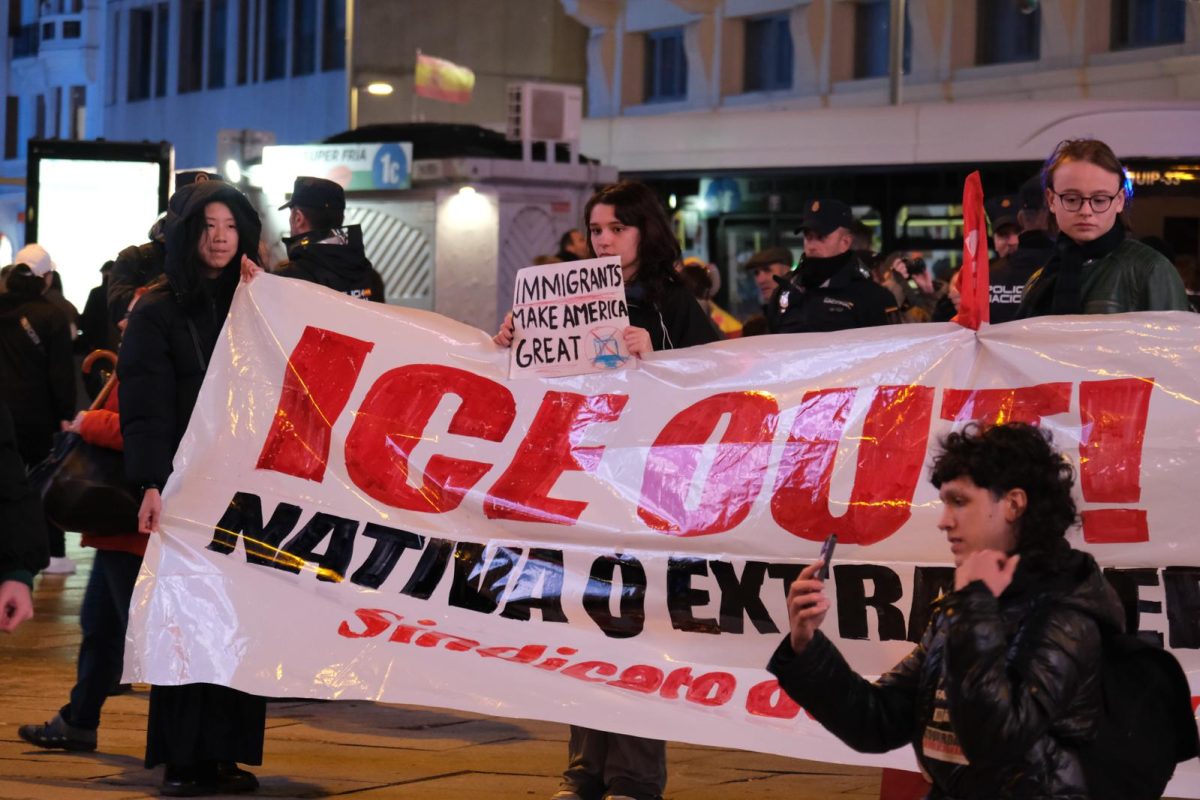
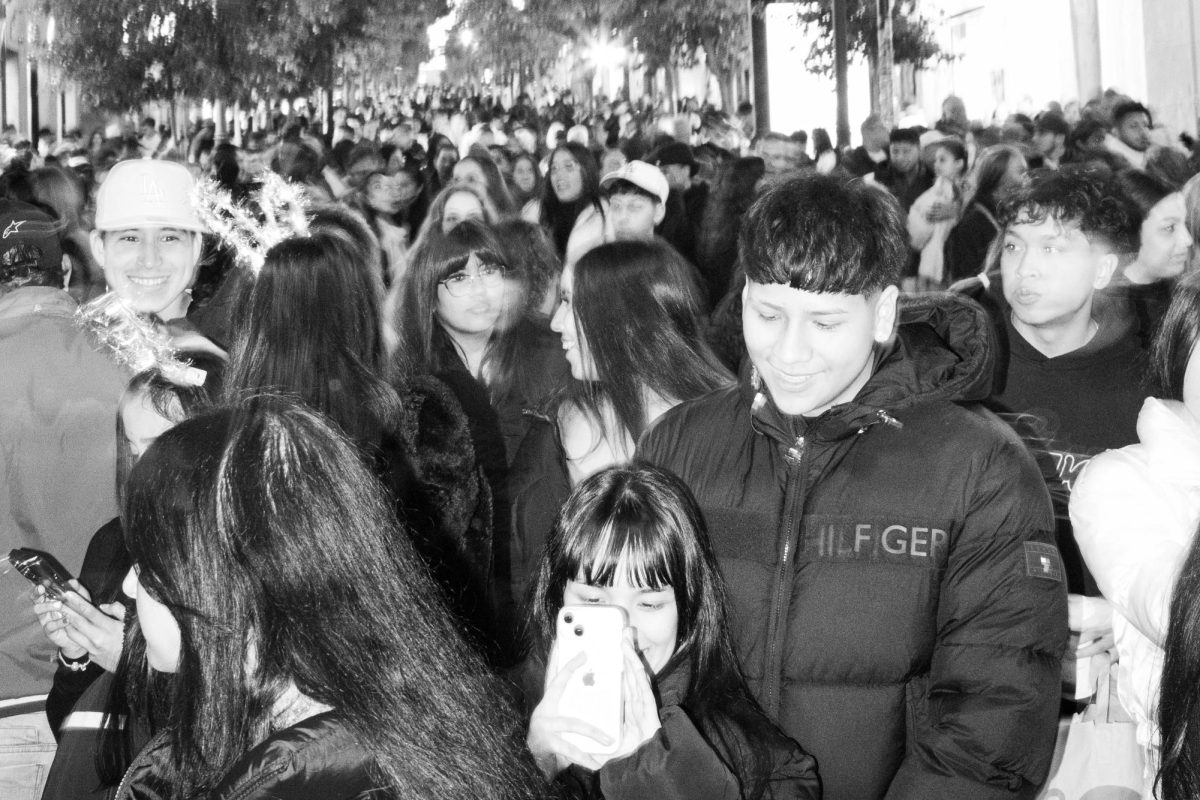
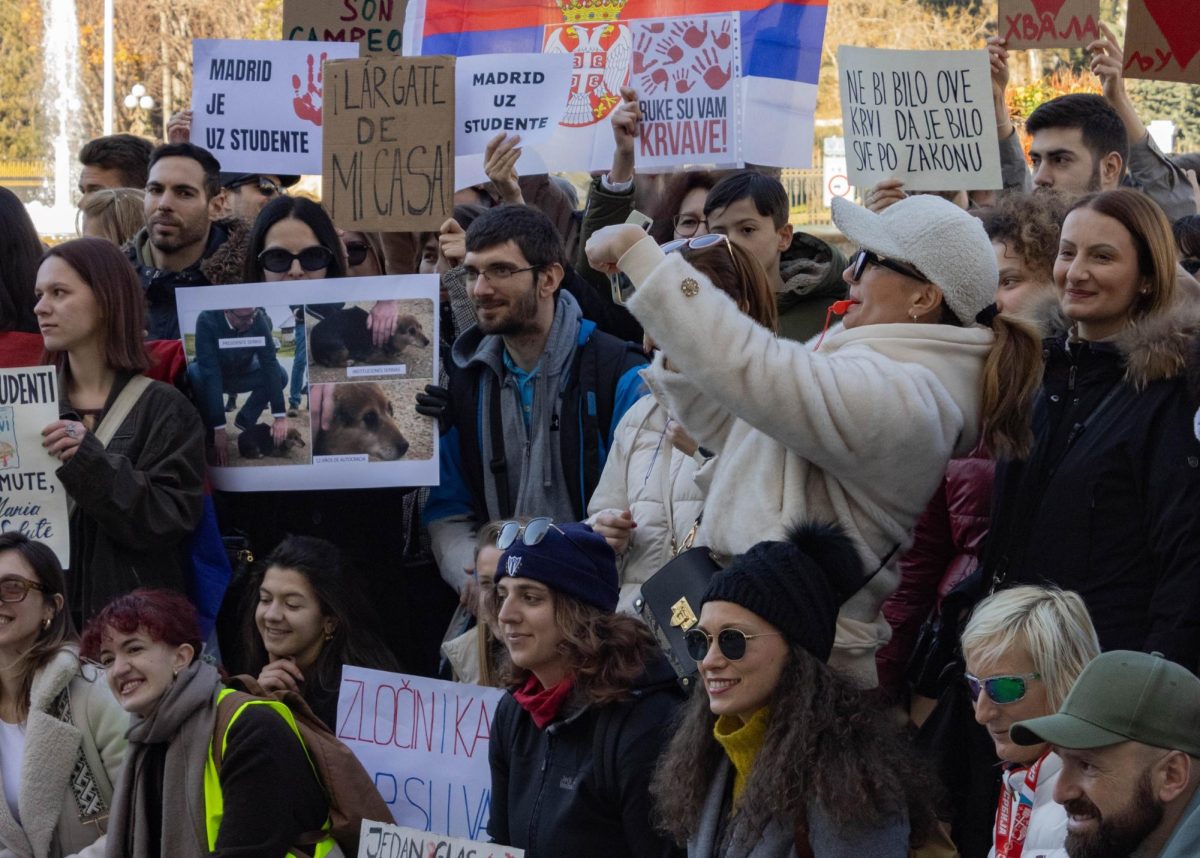
At the January student union protest, the crowd formed a circle around members of the organizations with megaphones and large banners which read “ICE Out! Trump Out!” Chanting filled Gran Vía as demonstrators recited, “De norte a sur, de este a oeste, ¡la lucha sigue, cueste lo que cueste!” Although their voices could be heard throughout the Plaza, the line for the Netflix Bridgerton pop up significantly outnumbered the protestors. However, the turnout still made an impact on the American students, “I’m actually shocked they’re doing the protests at all,” said permanent SLU student Isabel Brewer, 23. “It makes sense because of the subject, but it was mind-blowing to me to see anyone here at all.”
For American students abroad, this kind of demonstration is one of the few ways to stand in solidarity with movements unfolding back home. Isabel Sillers was born and raised in Minneapolis and is now a sophomore and permanent student at SLU-Madrid. “It’s a very clear feeling in my heart because it’s so close to home,” she said. “It’s my community and I have never felt so much like I should be there and not here.”
Other SLU-Madrid students echoed that sense of displacement, of watching history unfold from a distance. The protest served as an opportunity to take a stance despite being thousands of miles away.
“I’ve felt both powerless and also like I was doing my country a disservice by not being at home,” said James Heisel, a freshman at SLU-Madrid. “I still felt like I needed to be doing something. When I saw this was going on, I thought, ‘That’s a good start.’”
Senior Noella Connors described a similar motivation. “I can’t be home protesting, so I might as well contribute to something while I’m here in Spain,” they said. “The fact that Spaniards are here protesting for us speaks volumes about what is going on in our country.”
Some of the organization members weaved through the crowd handing out flyers advertising future demonstrations and collecting phone numbers on a clipboard. One member commented on being a Spaniard protesting issues within the United States.
“Ayuso, Almeida, Abascal, applaud all of the politics of ‘racist terror’ that are in the United States,” he said. “And we know that if they had the opportunity, they would be doing the same thing here; the only thing that stops them is that they know the working class here is organized and prepared.”
Sillers paused to jot down her name on the clipboard, but as the crowd chanted “Fuera el ICE de Minnesota!”, it’s clear her attention was elsewhere. “I have never felt so oh my God, I should not be here. I should be home,” she said. “Saturday he [Alex Pretti] was shot, and that night I looked up flights for the next day.”
Wanting to go home means accepting the risk that comes with it. For Sillers, buying a plane ticket would mean knowingly placing herself in harm’s way and returning to a city under siege, where the people she loves face real and immediate danger. “If I buy a flight then yeah, I’m in danger; but at least I know what’s going on,” she said.
But physical distance isn’t the only struggle. The seven-hour time difference often leads to an inability to stay updated about friends and family in the States, leaving Sillers and others waking up to news articles and missed calls.
“I was scared to go to sleep because something could happen while I was asleep,” she said. “It was just so much.”
But some news she receives is unexpectedly hopeful. Sillers was encouraged by friends and family who patrol the streets for ICE vehicles, alert neighborhoods to an ICE presence with honks and whistles, deliver groceries to families who are scared to leave their homes, move their cars during snow emergencies, and even pay parking tickets with a mutual aid fund.
Demonstrations like this one also reassured Sillers of the support abroad. A German Erasmus student, Paul Köhler, 17, found out about the protest through social media. “I am very concerned about what’s happening in America,” he said. “I wanted to do something at least like just a symbolic help.”
Still, the risks are incredibly real. “All my friends were on the ground,” Sillers said. “Several of them got tackled, pepper-sprayed. One of them has a huge gash from a tear gas canister that hit them in the side.”
Standing in the rain with a cardboard sign may feel secondary to what is happening back home, but for Sillers it is one of the few ways she can bring her community with her. The fear she carries is not abstract; it is specific, immediate, and tied to real names and real loss.
“Alex Pretti was tackled to the ground and they immediately shot him,” she said. “I imagine my friend Zach getting tackled to the ground. He didn’t die, but he absolutely could have. There’s no difference in those two situations—Alex and Zach.”