




Upon arriving in Spain as a political science major, I didn’t know much about the country’s political landscape beyond the Franco dictatorship, which ended almost 50 years ago. Last semester, I learned about Podemos, a left-wing party founded in 2014 by Pablo Iglesias to protest inequality and corruption.
Iglesias, who once served as Spain’s deputy prime minister, announced his resignation from politics in 2021 after losing the regional election in Madrid. His resignation only empowered him to instill his politics elsewhere.
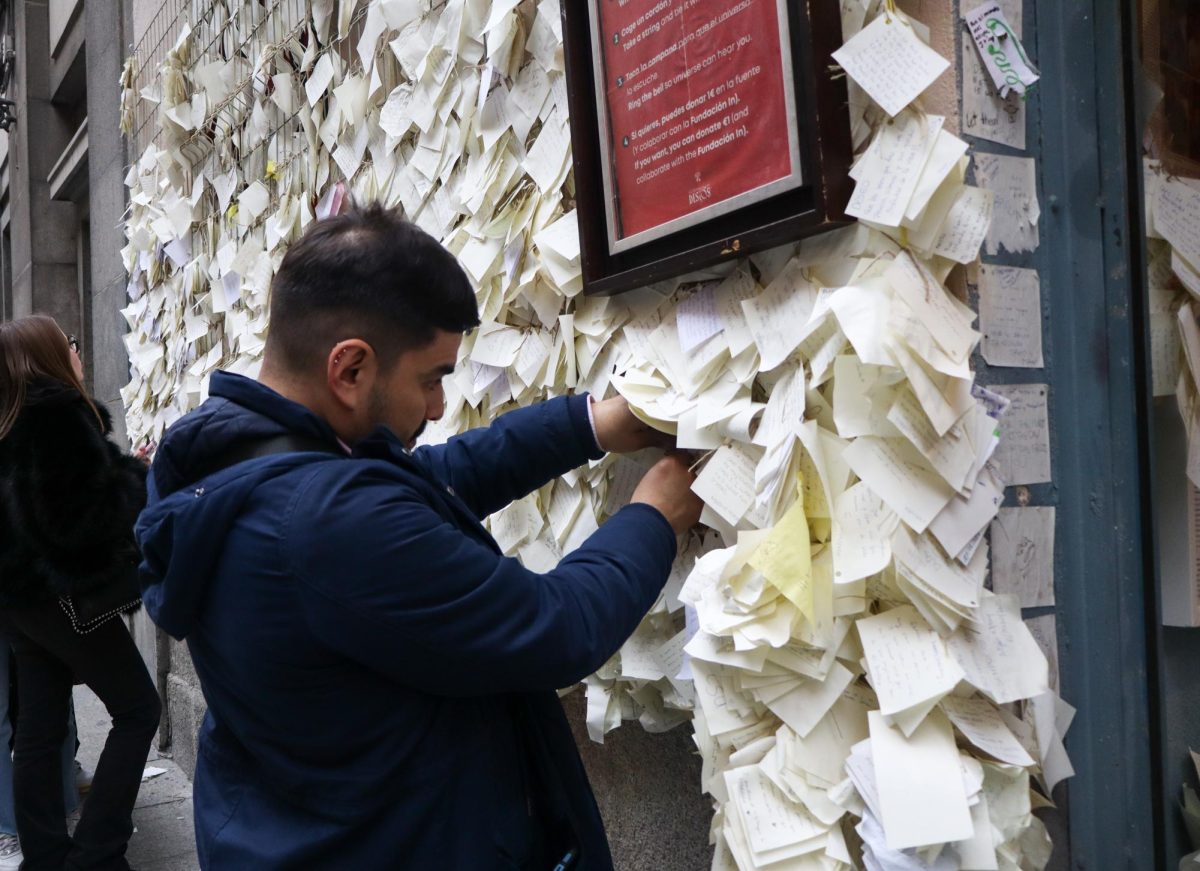
In 2024, Iglesias opened a bar on Calle Ave María in Madrid’s Lavapies neighborhood called Taberna Garibalidi. I decided to visit Iglesias’ own bar, curious to see how my studies would translate into real life and to see how his ideologies play into his mixology.
The bar’s name, Garibaldi, comes from the 19th-century Italian revolutionary Giuseppe Garibaldi, symbolizing unity and resilience. These metaphors are seen in Podemos’ social justice activism.
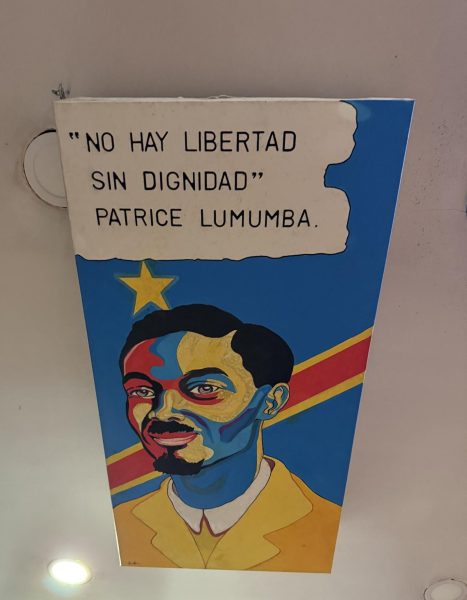
bar reads, “There’s no liberty without
dignity.” (Thea Uhl)
As I arrived at my boyfriend’s house, who had initially told me about the bar, I was welcomed with an alarming look.
“You can’t go to that bar looking like that,” he said, as I was wearing a semi-see-through long-sleeve shirt, not realizing that the bar’s relaxed dress code aligned with its political ideology. I changed from my usual business-casual attire into a plain T-shirt, fitting the bar’s anti-establishment vibe.
On the way to the bar, he was telling me all about the history of how the bar came to be.
It’s not his usual hangout spot, but he explained that Pablo Iglesias opened the tavern as a political space in a multicultural neighborhood in Madrid, where different languages mingled outside the numerous tiendas de alimentación from different countries lining the streets by Garibaldi.
I speculated that the Lavapies’ choice was deliberate. It’s such a multicultural place, reflecting the working class that Podemos has always fought for, even after its founder stepped away from politics.
I realized that the bar itself is a political statement, geographically and ideologically.
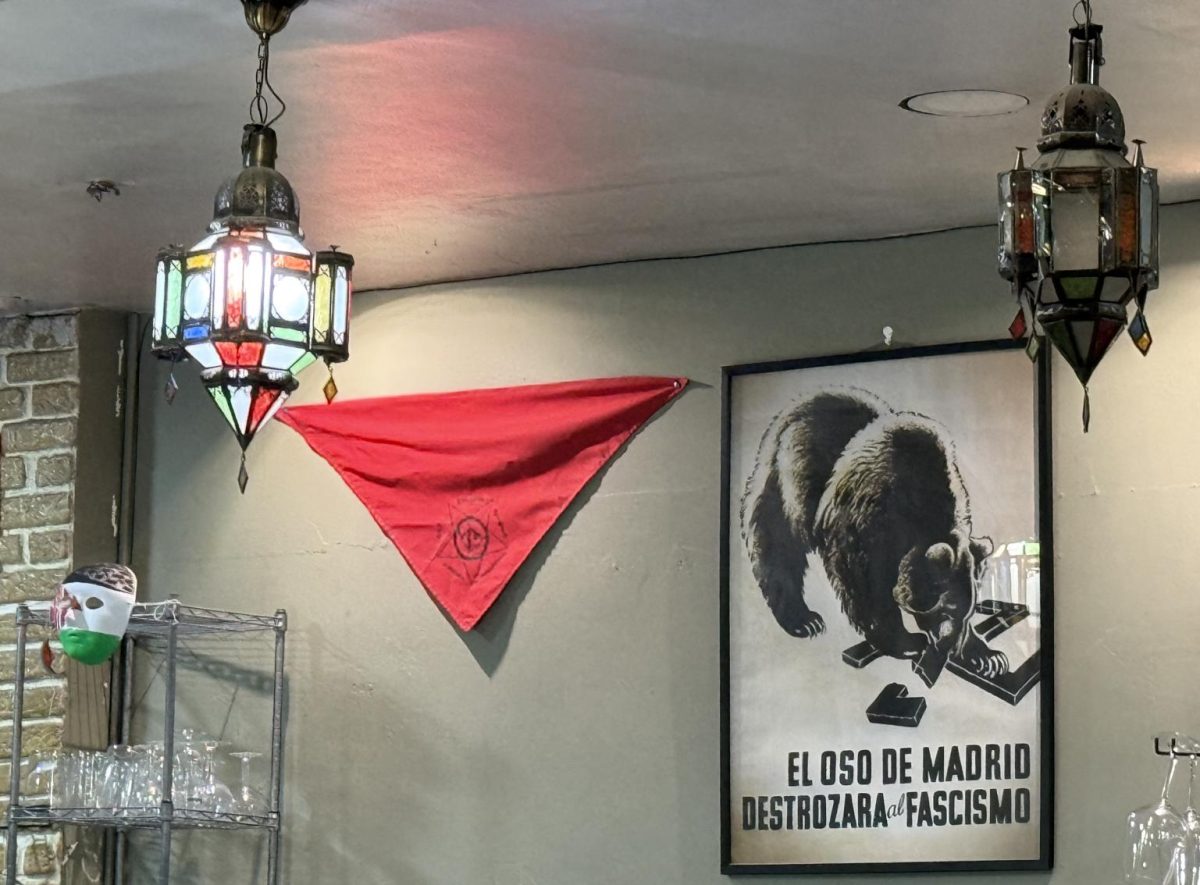
Inside the tavern, political symbolism is everywhere. Posters supporting labor unions and historical left-wing revolutionaries were displayed on every wall of the tavern, even on the ceilings.
One ceiling mural read, “Freedom is not something that one person can bestow on another as a gift,” a quote from Kwame Nkrumah, the first African-born prime minister of Ghana from 1952 to 1957.
The bar attracts artists and left-wing activists alike, hosting all kinds of different events such as live music and poetry shows. These events are advertised at the bar counter. The poetry events allow customers to share their work. The next event on the flyer was “Mama, I want to be a feminist artist.” The caption had “radical feminism” and “free Palestine” written as a descriptor of the event.
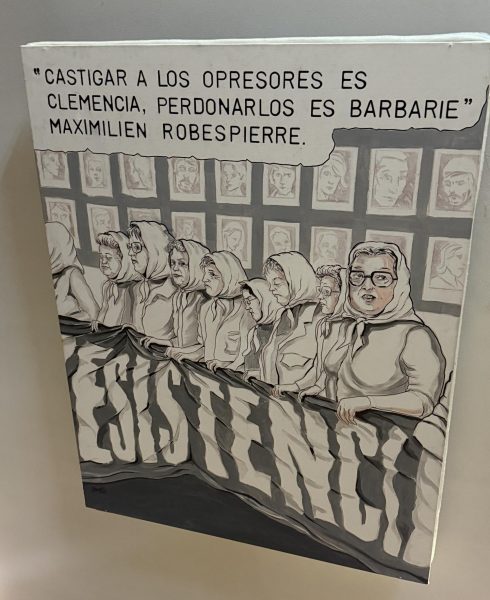
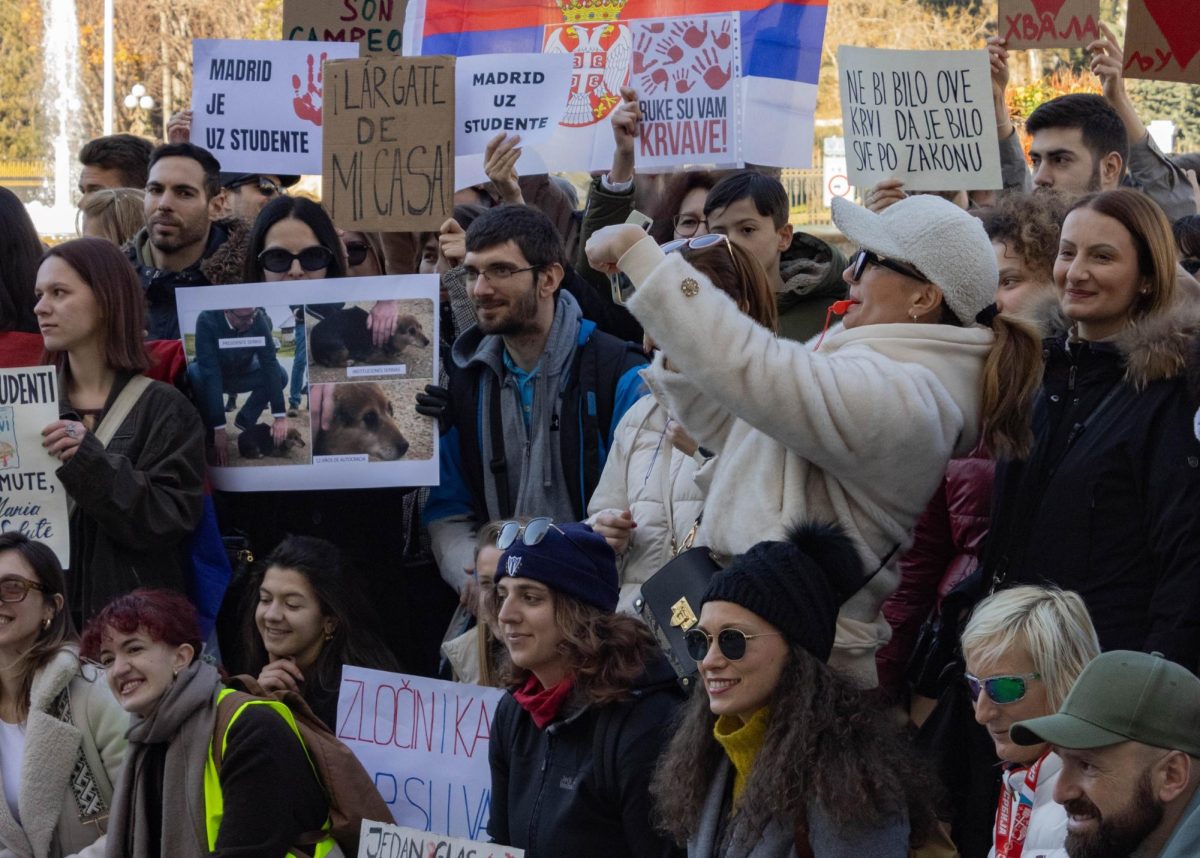
Regulars see the space as both a political statement and a place where culture and conversation come together over tapas. Posters near the bar counter also advertised upcoming protests, encouraging bar-goers to stay engaged with social causes that many may support.
I never expected that a cocktail could hold such a political message, but if any bar could pull it off, it would be this one. At a glance, I saw that the entire menu is named after major historical figures, events, and even Marxist concepts. Some names include Fidel Mojito (Cuba), Ché Daiquiri (Argentina), and Mandela Zulú (Mandela).
One of the cocktails, called the “Gramsci Negroni,” references Antonio Gramsci, who was an Italian Marxist philosopher and theorist. At the bottom of the drink menu reads, “Las tabernas son el último bastión de la libertad del proletariado,” or “the taverns are the last bastion of the liberty of the proletariat,” a quote noting the working class in Marxist theory.
When I started documenting my experience, I felt uncomfortable. Taking photos of the antifascist murals and posters felt intrusive; it was like I was doing something wrong. Bargoers gave a side-long glance as I put my camera up to snap a photo.
I felt like I was in a restricted space; maybe wearing something more relaxed wasn´t enough.
At that moment, I realized that, as a foreigner and student observer, I should try not to stand out too much.
Leaving the bar, I kept thinking about the tension between my studies and the political reality I had experienced, seamlessly masked by cocktails.