











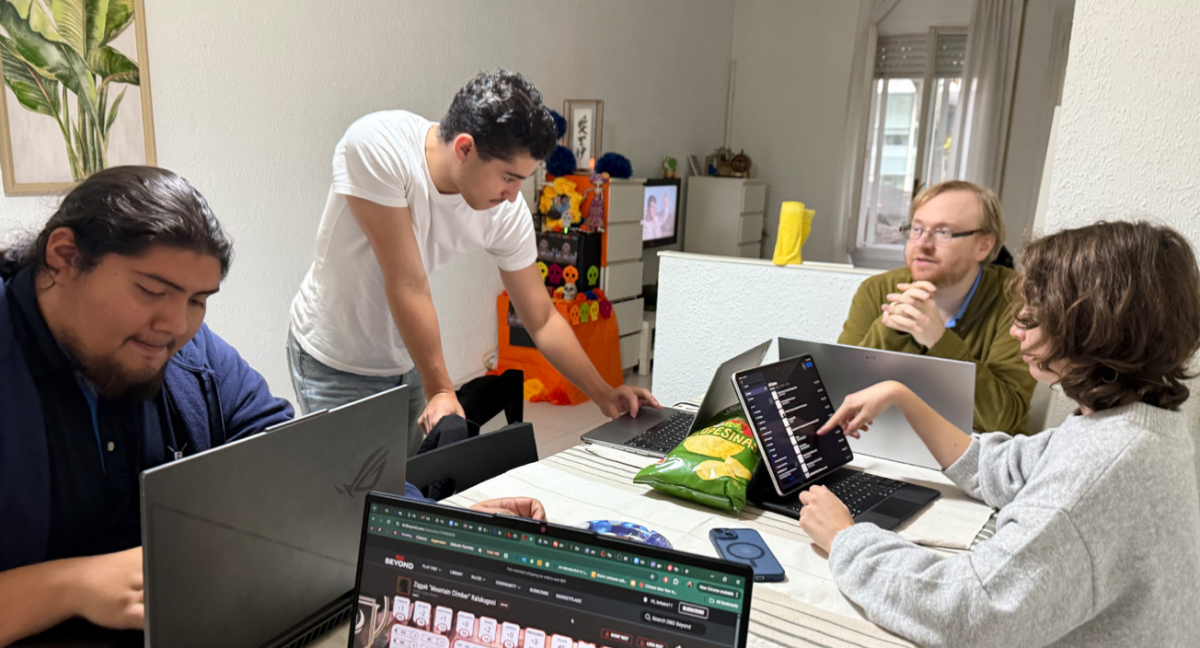
In the first encounter, Gilamesh, an older man who looks as though he’s lost a kingdom, brings down his morningstar, a spiked club on a very large stick, on the nearest goblin. The goblin, a nasty short green creature, stands dazed. From behind Gilamesh, a gray-haired woman in her 60s calls on the power of her god, and a thunderclap sounds as lightning strikes the goblin dead.
Huwani, the youngest of the group, is dressed in what you might imagine a monk to look like. He spins his quarterstaff, taking out two of the goblins at once. Normally, this wouldn’t be allowed, but Ryan, the GM, or game master, invokes the “rule of cool.” Two hobgoblins approach (imagine a goblin the same height as you), and David, playing Huwani, pauses to Google martial arts moves in order to properly explain the logistics of how he puts a creature in a chokehold.
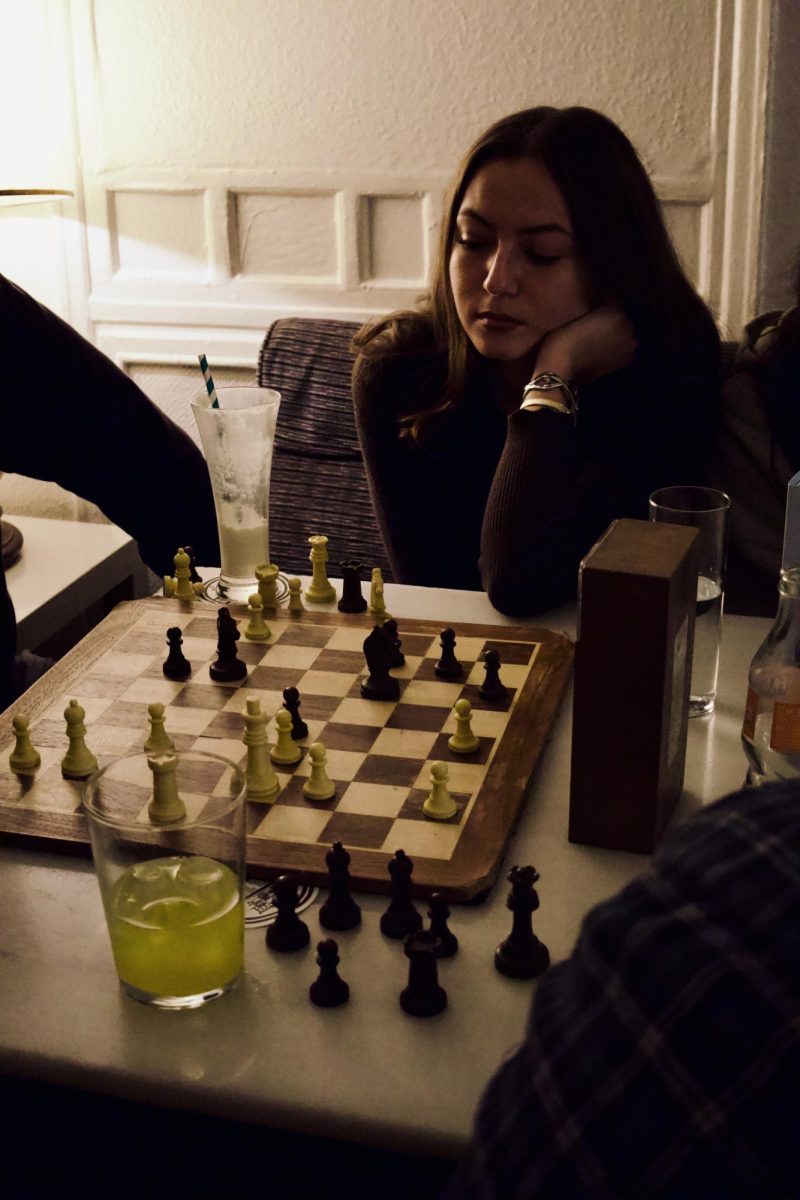
Ryan Cantwell, David Chavez, Antony Chavez, and Clara Martinez meet every Friday night, rotating between apartments and living rooms, at 8 p.m. Usually, computers, character sheets, snacks, dice, and a few other board games, like Catan, are scattered around a table. After a 20-minute conversation spanning everything from the movie Parasite to Dr. Li’s Political Methods class, the group settles in to play.
During quarantine in 2020, people picked up all sorts of new hobbies: making whipped coffee, becoming Chloe Ting workout fanatics, and playing Dungeons and Dragons. Dungeons and Dragons is a TRPG, or a Table-top Roleplaying Game. Half of Dungeons and Dragons, or D&D, is asking clarifying questions to the GM: Can I use the speak-with-animals spell to command a door to open? Is it dark in here? Would my character know that that is definitely not a Drow (a subrace of elf)? The other half is doing math. Characters move through the world through a series of skill checks made with dice. You may roll a D20 (20-sided dice), D8 or even a D100 to determine your odds and the result of an action of your choice.
For David Chavez, a sophomore at SLU-Madrid, D&D showed up in his life at a Halloween party in high school, freshman year. His friend pulled out some Pathfinder books, another TTRPG, and they created some characters. David made a turtle cleric, or healer. “That was fun. I got slingshotted into a wall,” Chavez recalls.
Sophomore year of high school, Chavez and his friends created a D&D club. It only lasted a year, but it sparked his interest. In the campaign he’s playing now, he’s Huwani, a half-orc monk of the church of Ill-matter. “Huwani’s character is like a coming-of-age story, of him leaving whathe’sknownhisentirelife,andexplor- ing the world,” Chavez said.
Going into the campaign, he had a few ideas and was attempting to balance his rolled stats with what would best benefit the party as a whole. Chavez was drawn to half-orcs in particular. “A big burlyguythat’sotherizedbysociety,” said Chavez, “I kind of sympathize with that.” “I’m technically mixed,” he added. “I’m half Indigenous and half European. I also share that feeling of social other-ing. That idea is very central to the idea of what half-orcs are.”
The church of Ill-matter was also part of it. For RyanCantwell, a business student at SLU-Madrid, D&D became a way to connect with people during quarantine. He played on Discord and made new friends who were in similar situations.
In Cantwell’s first-ever campaign, he played a dragonborn. “My character was Blue Musk, the son of Elon Musk, a drag- on,” said Cantwell. “He was following in his father’s footsteps to accumulate as much wealth as possible and sitting on it.”
But Cantwell isn’t any regular D&D player. He’s the GM, or Game Master. He started GM-ing after playing six or seven campaigns himself. “When I ran out of campaigns to play, I had to build my own,” he said.
For Cantwell, the best part about building worlds is making the impossible make sense. “You have no limits on your thought, or how characters interact,” said Cantwell. “Things can happen realistically, unlike in the real world, where things happen comically at best.”
The hardest part about organizing, planning and running a campaign, though, is “herding cats.” Players have their own lives, and getting everyone to show up at a session can be “nearly impossible,” said Cantwell.
Antony Chavez, a freshman at NYU’s Madrid campus, started playing D&D during COVID through Roll20, an online D&D platform. His first-evercharacterwas a yeti-ified Gorbachev.
“At the time I was learning about the Russian revolution and the USSR, and so when we were playing, I decided I might as well use him as a reference– as to why, I don’t really know,” he said. “I didn’t really have a backstory for him, I only had a pic- ture I edited to make him look like a yeti.”
During quarantine, the campaign petered out, but in his junior year of high school, he and his friends started a D&D club.
“Our math teacher was really leading the club,” Antony recalled. “He was a D&D enthusiast. He ran his own campaigns, he knew all the stuff, he taught mehowtobuildacharacter,whatIshould know for a campaign.”
In his current campaign, Antony Chavez is playing a character named Gilgamesh, based on the legend. “When I make a character, I can’t think of anything on the spot. So I have someone else as a placeholder, but usually the placeholder becomes the actual character,” explained Chavez.
“It’s always based off what I’m learn- ing, or what I’ve heard recently. Gilamesh was because we were talking about the legend of Gilgamesh, and I thought ‘this is such a cool story,’ ” said Chavez. His next character in the works is Sisyphus.
“[D&D] is challenging me to be more creative,” said Chavez. “I can try to create something different or new from what I know.”