














Javier Sauras walked down Nanjing Road in Shanghai, China, taking pictures of everything in his field of vision with his new Nikon D90, one of the first DSLR cameras able to record video and take photos, and Sauras’s first camera ever.
Sauras took pictures “indiscriminately” for his first photo-related assignment. He walked back and forth down the road using a blend of instinct and confidence to determine the angles and camera settings with which to document temples, modern buildings, commercial ventures and anything else in his line of sight.
“I knew nothing,” says Sauras. “I had to learn everything online, basically, little by little.”
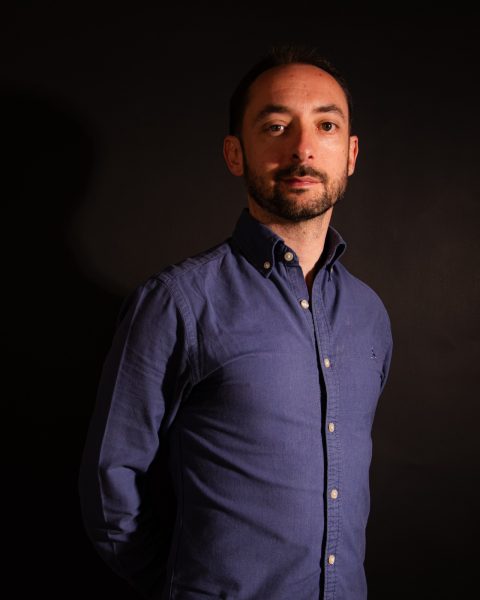
Today, 16 years after picking up his first camera, Sauras is working to expand the multimedia learning options for students at SLU-Madrid. As a recently hired, full-time professor, he shares principles of photojournalism, film, and communication with students. Sauras is one of the faces behind a new media lab and student film festival, both the first of their kind on SLU’s campus.
“The student body here at SLU is more creative than in other places,” Sauras says. He hopes that his work to expand the communications program’s services will help students express themselves freely and build skills that translate beyond campus into future careers. Sauras, who found his love of teaching during his PhD program at Columbia Journalism School, brings this passion for helping students develop real-world skills to class by asking questions.
In his self-proclaimed “favorite class” of the year, Sauras plays a clip from Stranger Things for students who look back and forth between the intense D&D game on the screen and PDFs of the original script on their computers.
He pauses the episode right after the disappearance of Will Byers, bringing students out of their intense focus on the fictional world with a question, “What did you notice? What did you learn?”
Sauras listens intently as students share differences they noticed between the script and the show before adding his own observations. After hearing the main point of each student, he pushes them to think more deeply, asking, “For example?” and “Why do you think they did that?”
“He helps you sort of get to the answers on your own,” says Sofia Ordoñez, a student in Sauras’ Introduction to Digital Media Production course.
“It’s just the journalist in me,” says Sauras. In classes that focus on subjective subjects like the arts, Sauras isn’t interested in right or wrong answers, rather in hearing what his students have to say and creating an exchange of ideas. “I see teaching as that,” Sauras says, “as a collaboration between a student and a professor.”
Sauras developed his skill sets by trying anything and everything that piqued his interest and could help him advance his career. “I’ve always been very playful, and I’m always interested in a thousand different things,” he says. “Everything that I enjoy, I try to explore it a little bit. And I try to see whether I can do or create or understand it a little bit.”
Throughout his career, this open exploration has led Sauras to explore interests in written journalism, photography, video, multi-media, and non-linear storytelling that turns news into a “Make Your Own Adventure” story. Sauras tries to offer this freedom of exploration to his students by encouraging them to apply their personal interests to assignments and projects.
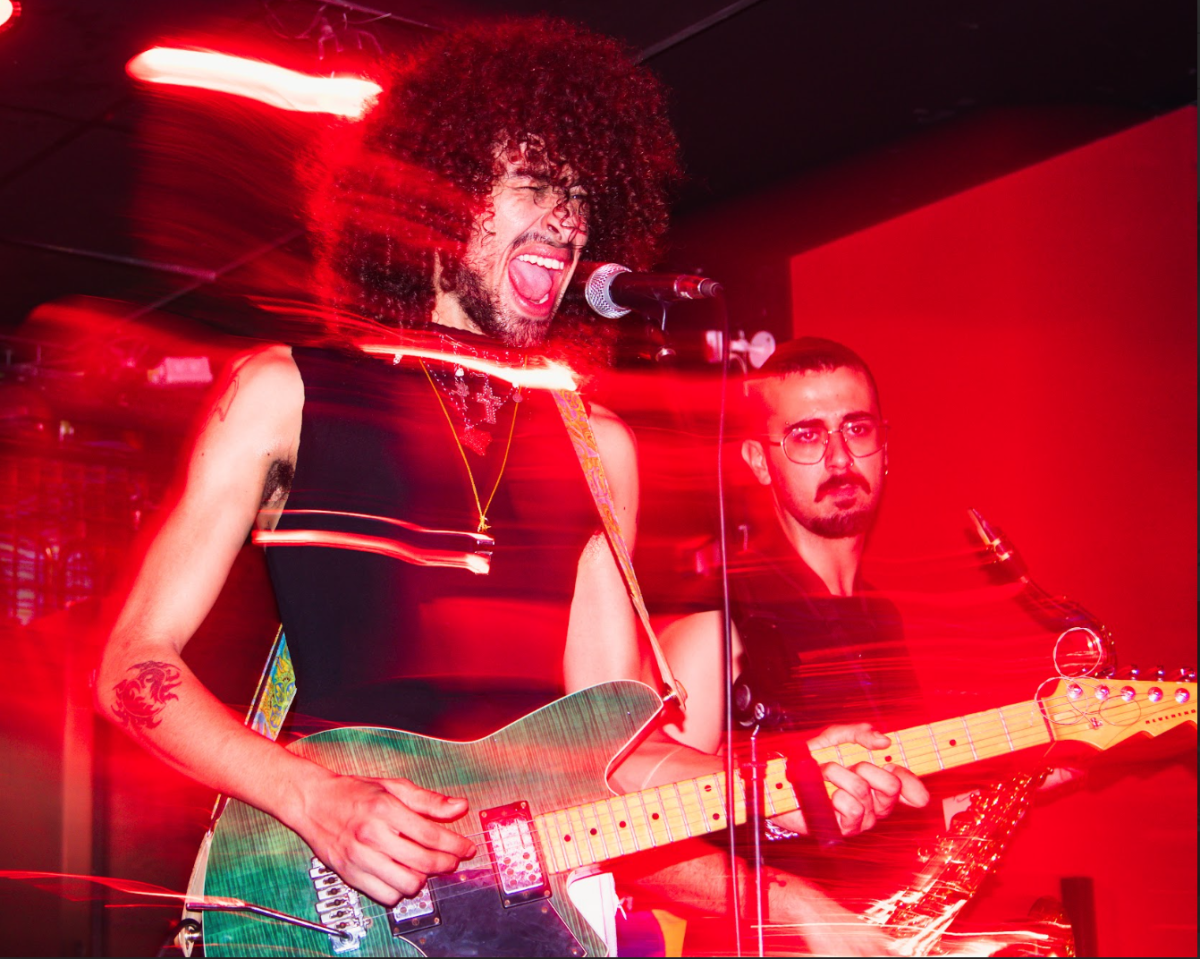
Last semester, in his Introduction to Digital Media course, two students were working on a project about the process of creating a song. “I would be absolutely incapable of doing that,” says Sauras, “but I know that the students can do it so whenever they express some interest in doing something, even if I know nothing about it, I try to, you know, encourage them and at least accompany them through the process.”
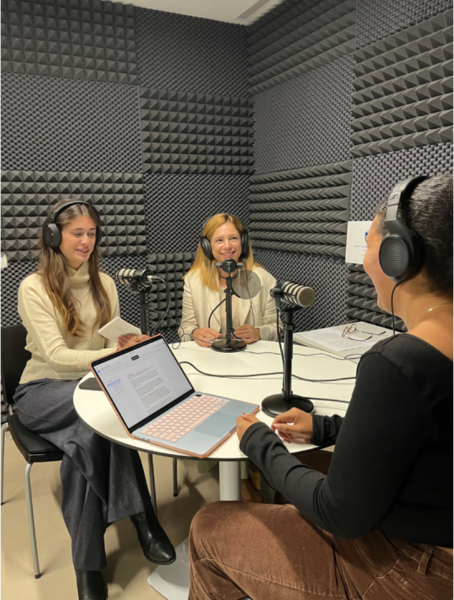
In Media Production, Ordoñez incorporated her personal interest in Korean culture into an audio assignment, and Sauras helped her access sound resources and perfect her editing techniques. “I feel like because I have that creative freedom I can choose subjects that I’m passionate about,” Ordoñez says. She said that having the space to link her passion to school projects keeps her more motivated than when a prompt is “just sort of handed to me.”
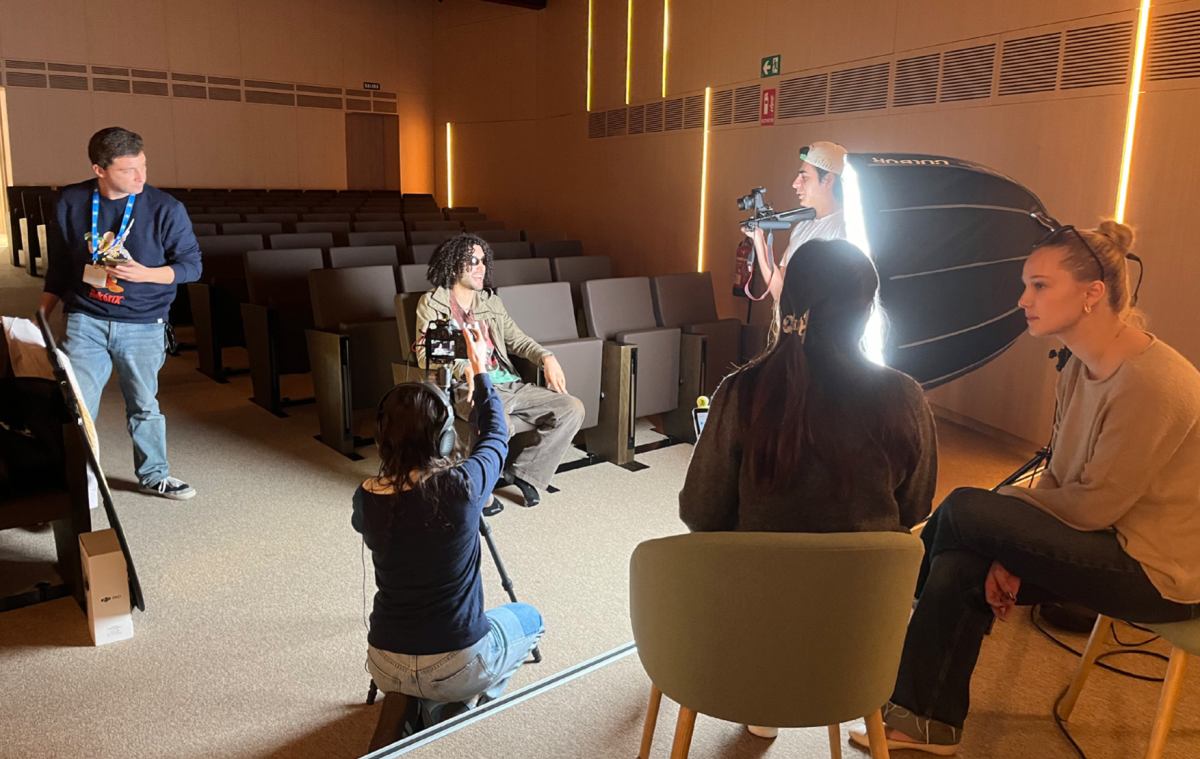
Sauras facilitates a similar exploration in the new campus Media Lab. “Every week now, I have new projects coming to the lab that maybe are not connected to my classes at all, but are just a living proof of how creative this school of students is,” says Sauras.
Agatha Thomas, a recent graduate who took a digital media production course with Sauras during the Fall of 2024, remembers the excitement of seeing the media lab come together.
“He was, like, telling us that he would be soon showing it to us for a few classes before,” she says. “We were all so excited to go and then he was just showing us every piece of equipment and kind of like letting us mess around with it.”
As a senior, Thomas regularly used the medialabtocompleteprojectsforclasses in all subjects. She created a video for an English project and used the Media Lab’s green screen and podcasting room.
“You have the space to be creative and have the room to yourself and the equipment to yourself,” Thomas says, “butalsoyoudon’tneedthebackground knowledge because there’s always people there.”
Sauras hopes that he and his colleague’s work establishing SLU’s student film festival will allow students of all majors to explore digital storytelling even further.
Rosana Vivar Navas, director of the communications program and co-producer of the student film festival, highlights Sauras’ creative problem-solving role in the organization of the event. She remembers sitting down for coffee at a local coffee shop with Sauras when the plans started coming together concretely. “We went for coffee with our little notebooks, and we were like, ‘Okay. What do we need? How many awards do we want?’”
While no longer the main award of the festival, Navas recalls Sauras developing the idea of the “Golden Billiken,” a trophy in the image of the golden globes to celebrate student achievement in a playful way. “We realized that 3D printing wasn’t an option…and he immediately started to look for companies, for trophies,” she says. Sauras once again applied his journalism skillset when planning the festival, approaching it with the question, “What is it that I would have enjoyed as a student?”
Sauras encouraged students of all majors to participate in the first annual festival, which took place last spring. “It’s a great opportunity, even if your short film is not selected,” says Sauras, “Just going through the process, thinking about an idea that maybe is not connected to a class, but it’s away of expressing yourself.”